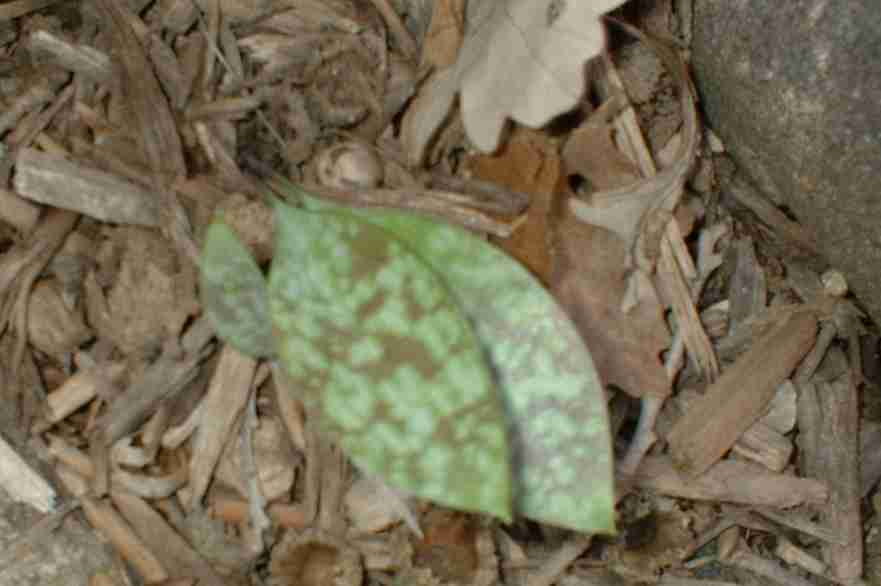
 weed, but the last time I said that, I ended up with a vine of some variety overrunning my cucumbers in the garden. So Ill watch this very carefully, and try to look it up. If anyone can identify it, send an email.
Saturday, April 29
29 April - What is this?
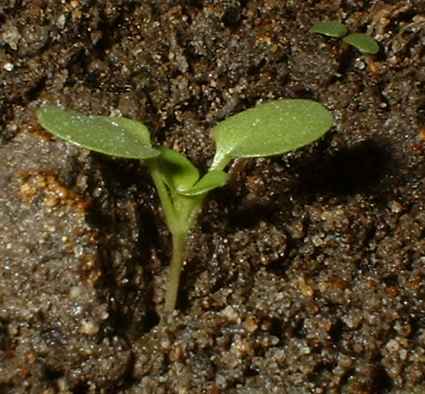
I spent part of today weeding the rock wall, which seems to be breeding a healthy crop of dandelions this year, and came upon this. I haven't the slightest clue what it is supposed to be, the leaves are about 2-3 inches long, mottled brown and green, and glossy. It doesn't look like a
 weed, but the last time I said that, I ended up with a vine of some variety overrunning my cucumbers in the garden. So Ill watch this very carefully, and try to look it up. If anyone can identify it, send an email.
weed, but the last time I said that, I ended up with a vine of some variety overrunning my cucumbers in the garden. So Ill watch this very carefully, and try to look it up. If anyone can identify it, send an email.


Sunday, April 23
23 April - getting the garden ready
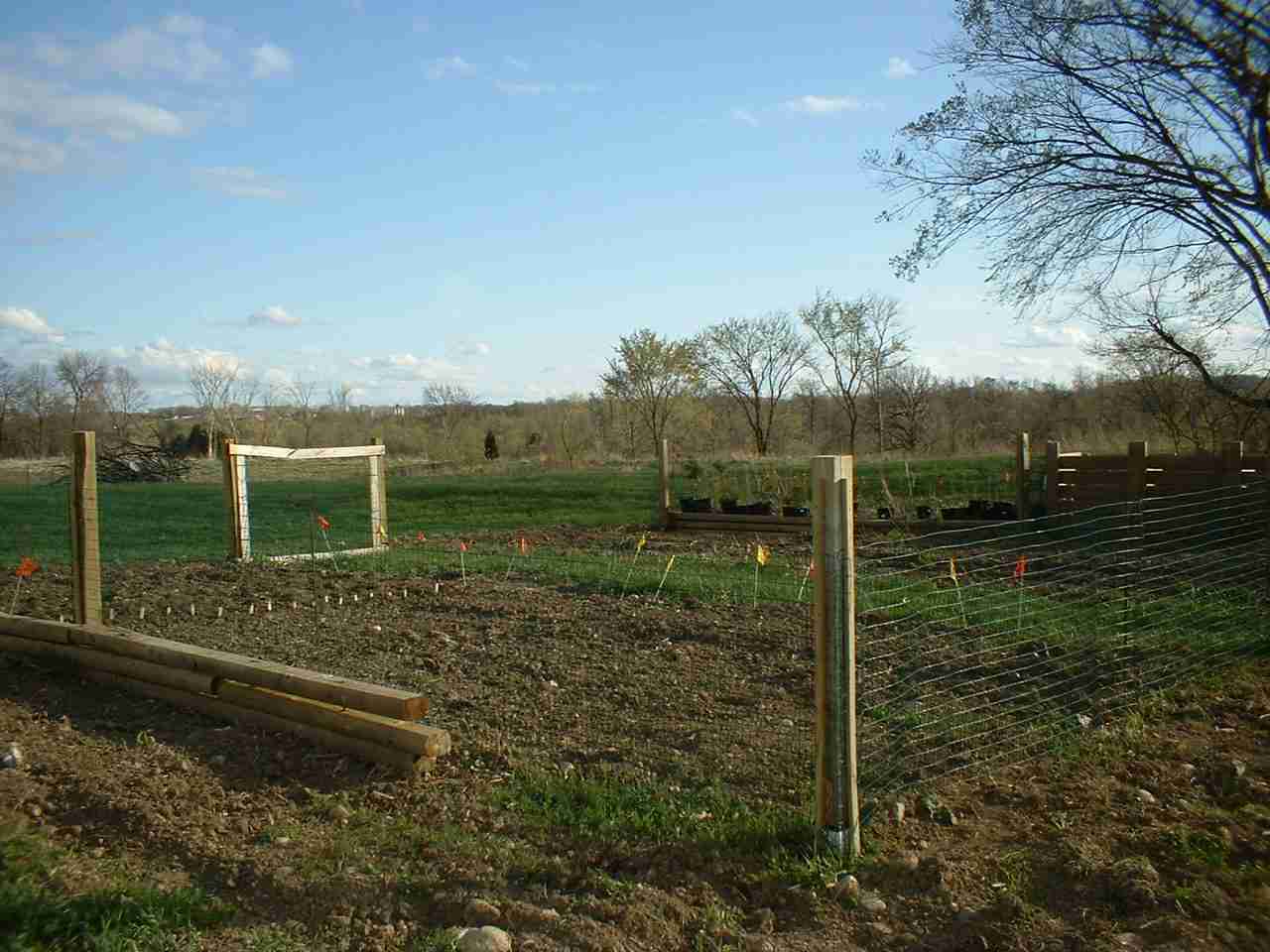
The garden is tilled, and most of the fencing is back up. (and some of the raised perennial bed is placed, the timbers in the front.) You can also see the row of markers where I planted 300 onion sets.
Yes, the flags are courtesy of digger's hotline (from the last round of work on our front yard), but no, they don't mark buried utilities.
Some dimensions for you, the garden is about 30' x 35', with a 5-foot pathway through the center (for driving the lawn tractor) To the rear of the photo, you can see the compost bins, and the seedling bed for the trees we get from the DNR program. The gates need to be upgroded (you can see the crack in the frame), but that can wait for a slow spell in summer.
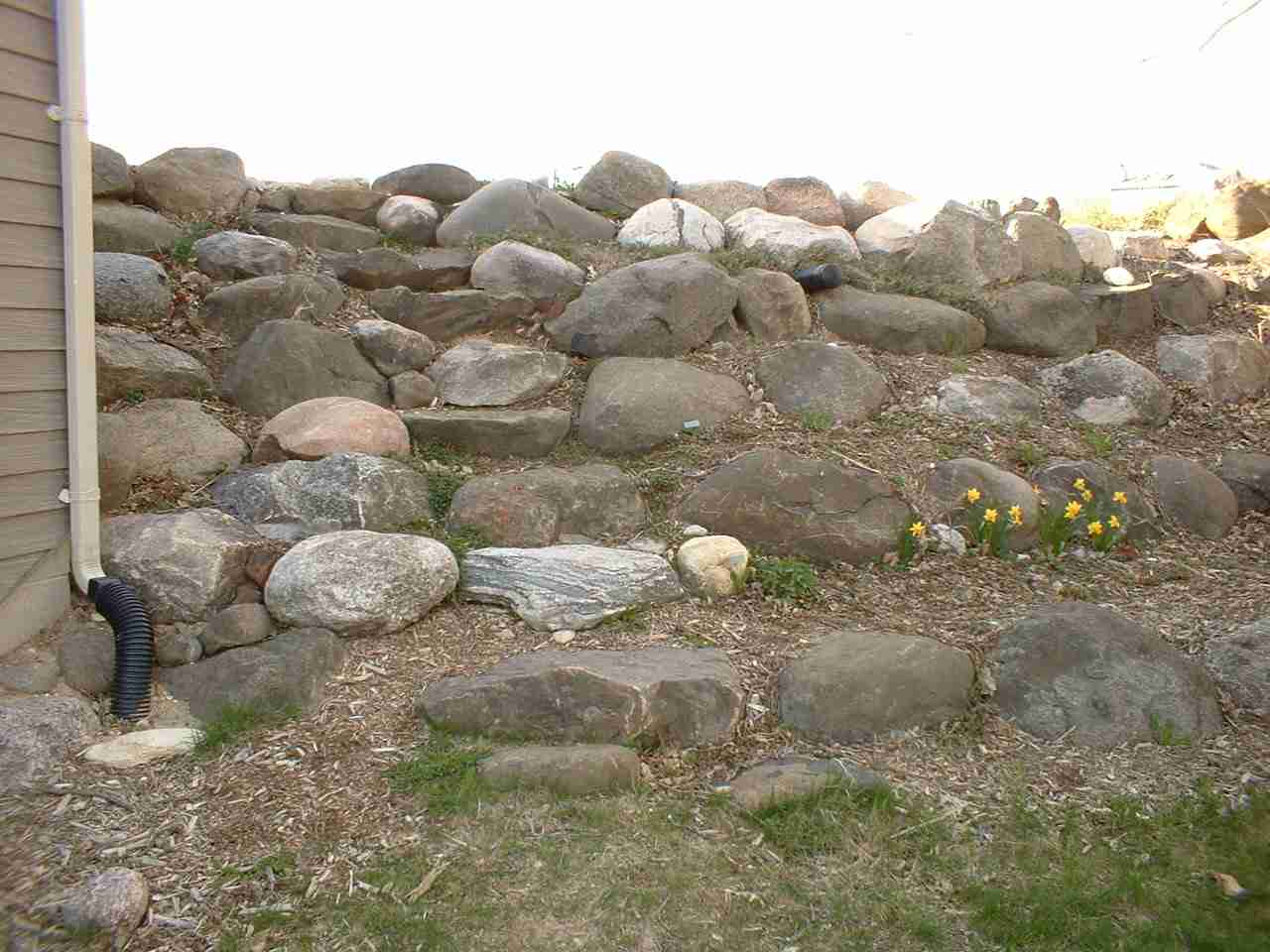 The rock wall is starting to recover from winter, you can see the Daffodills are in bloom, and the green patches are strawberries, herbs, and creeping phlox.
--
Saturday, April 15
15 April - Easter Saturday
Early warm spell here, it's been 80 degrees for two days now. After a few thunderstorms this week, the sunny weekend is allowing me to prep garden beds for planting.
The front electrical box bed is weeded, the mulch raked to the inside, and I'm adjusting the rocks for a smoother edge to mow around. The weeds had already sprouted, so I had some visual help where to dig up the roots. (after 20 years of this, I'm finally learning to weed the entire root system before I plant to reduce work later) Since the soil is still significantly clay, adding an inch of peat moss should help break up the clumps. Stella de Oro Daylilies were planted. They will bloom all summer and provide consistent color for years. I'll expect to dig and divide them in a few years, but that will just give me more lilies to plant elswhere.
--
The front electrical box bed is weeded, the mulch raked to the inside, and I'm adjusting the rocks for a smoother edge to mow around. The weeds had already sprouted, so I had some visual help where to dig up the roots. (after 20 years of this, I'm finally learning to weed the entire root system before I plant to reduce work later) Since the soil is still significantly clay, adding an inch of peat moss should help break up the clumps. Stella de Oro Daylilies were planted. They will bloom all summer and provide consistent color for years. I'll expect to dig and divide them in a few years, but that will just give me more lilies to plant elswhere.
--
Sunday, April 9
April 9 - Garden Chores
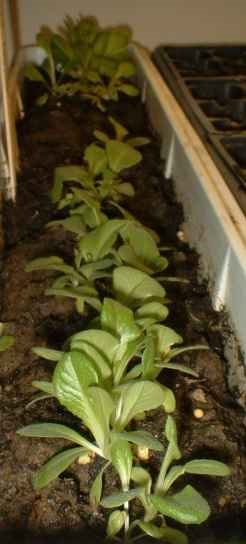 As you can see, the sprouts are doing great - the strawberries and lettuce are pictured
 at the right. Most of the grasses have graduated to windowsill status, and made room for the nexd batch of seedlings. The Impatiens are not doing so well, however. I think the pelleted seed is not properly getting soaked by the bottom-watering (several have sprouted in the last week since I've been top-watering those trays.) We'll see how they do for a late May planting.
Peppers and Tomatoes are being started as space permits. They do take up quite a bit more room than the rest (I'm starting them in quart containers)
The garden is getting an overhaul this spring. We've squared up the corners and installed permanent fencing along two sides (the tiller needs to access the rest, so two sides have semi-permanent fencing). I'll post more photos as we get it set up. The side will have flower beds, the other side will have the compost bins and tree seedling beds. It's starting to look like a planned feature, rather than a haphazard one.
--
Sunday, March 12
12 March 2006 - Spring?
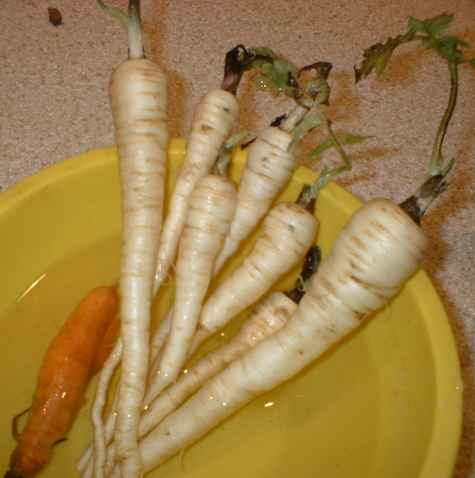
Maybe this should be called 'fool's spring'. Middle 50's, a thunderstorm, and the snow is melted, save for those patches clinging to the north side of a rock or wall.
So, what does one do after a thaw like this? In the past, I'd rush out to the garden, start working up the soil, and getting stuff ready for planting. In the past I'd also create globs of clay, lumps that would never work themselves out throughout the season, and ruts in the lawn.
I like to think I'm older and wiser now, so I just rush out and dig up the rest of my parsnips! Well, parsnips and one pretty sad looking carrot. Both are biennial plants, flowering and seeding the second year, and show no harm for spending the winter in the ground. (the carrot looks like it became a midwinter snack for a mouse or vole). All of these had already sprouted some green leaves this year, and if they were in a better location, I'd have left one or two to go to seed - parsnip seeds are difficult to store (or so the books tell me, I've never harvested my own).
Now, for all those folks who didn't grow up with grandmothers used to feeding 9 mouths on pennies, I'll share with you what parsnips are. Parsnips (the things that look like white carrots in the photo) are root crops in the same family as carrots, parsley, celery, and Queen Anne's Lace (the weed). For those that play Trivial Pursuit, the family is known as umbelliferae, due to the umbrella-like flowers. Freezing parsnips converts some of the starches to sugars, giving them a better flavor. Use parsnips boiled, roasted, or stir-fried. They are a good source of vitamin C and Potassium.
I like to add them chopped to soups and stews like carrots. They tend to be more earthy.
Wisconsin Garden Spring Chicken
2 bnls skinless chicken breast halves - browned, cut into cubes
1/2 cup chopped onion
1/2 cup chopped parsnips
1/2 cup chopped carrots
1/2 cup chopped celery
28 oz chicken broth OR equivalent water and bullion OR tomato vegetable juice drink
2 teaspoons Worcestershire sauce
Dash Hot pepper sauce
1/4 teaspoon peppercorns, smashed or not
2 bay leaves
1 teaspoon garlic powder
(optional) cooked noodles
Add everything to the pot except the noodles. Simmer until the vegetables are tender. Serve over noodles. If you prefer a more watery soup, add more broth or water while simmering.
--
Sunday, March 5
Seed Saving
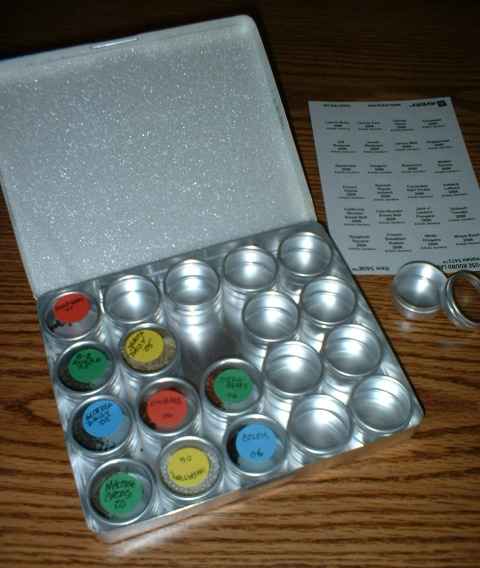 After ordering an average of $20 in seeds each year, I'm loathe to waste them. Now, $20 may not seem to be much for garden plants, but why should I order the same seeds every year when I can get a few years off each packet, and even more years worth by allowing a few plants to go to seed every year?
I use a watchmaker's case to store the seeds. This one was purchased for about $5 at American Science and Surplus, but they can be ordered online. The set has one large aluminum box, with foam padding in the lid, and twenty small aluminum cases with glass windows and friction-fit lids. The cases come in a variety of sizes and can be ordered online from Lee Valley Tools. This small size is 33mm diameter, and holds about a tablespoon. Larger seeds such as beans or corn might do better in larger cases.
 Since identifying seeds is not a strong suit of mine, I choose to label each container. White or colored 3/4" inkjet labels are perfect for this. I can print out a whole sheet of labels when the seed order comes in, and use only what I need to store. Using removable labels makes recycling containers easier.
Mark the seeds with the year they were intended to plant, or the year following harvest (if you collect your own). This will help predict germination rates when you use them the following year. I keep the entire box of seeds in an unheated corner of my basement, which stays around 50-60 degrees year round. If moisture is a problem, use a packet of desiccant to absorb the humidity (found in shoe boxes, packing materials, etc, and labeled "desiccant do not eat"). It can be purchased at craft and hobby stores under the names Silica Gel and Calcium Oxide.
Never saved seeds before?
It's only as difficult as you choose to make it. The easiest seeds to save are dry beans and corn, which can ripen on the plant naturally and be collected at will. Some plants, like parsley and dill, can be saved by tying a bit of row-cover around a nearly-ripe seedhead. Let the plant naturally ripen and dry the seeds, and collect them. Other plants, like tomatoes, require the seeds to ferment for a few days before drying. Books such as The Seed Saver's Handbook or Seed to Seed can be valuable resources. Online resources are also available, such as the International Seed Saving Institute, where you can find directions for many common vegetables.
--
Saturday, February 25
Sprouts
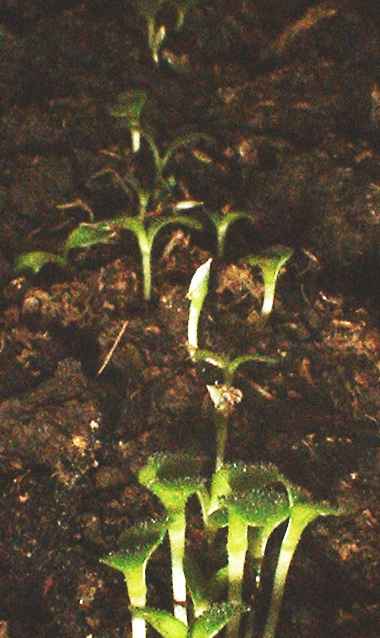
After a week of neglect, I have sprouts. (missed a watering, and had lots of dry and wilty looking plants)
The sprouts to the right are lettuce. I'm growing them in a trough this year to keep the slugs out of my greens. 12 hours and 3 cups of water earlier, these were pretty sad little sprouts.
So far, two plants have died from damping off, and maybe one more has died from neglect (wilt). But a good record nonetheless. I'll have to start trimming the perennial grasses soon - they're nearly 4" tall, and I want them to stay shorn until they can be moved to a window.
The rose seeds (Rosa Rugosa) are nearly complete from the heat-treatment, and start cold treatment this coming week. After three months of cold, they'll be potted up and hopefully sprout this year. In another year or two they can be transplanted outdoors. With some luck, 8 or 10 will survive that long, and be planted as a flowering hedge along the road.
And the Strawberry sprouts (here's the healthiest):
--
Subscribe to:
Posts (Atom)